Ceiling Lights
Ceiling Light Height Rules for Low Ceilings
If you buy through links on this page we may earn a commission at no extra cost to you.

Two numbers decide almost every ceiling-mounting decision in a bedroom: 7 feet and 8 feet. Seven feet is the clearance a person needs to walk under anything without bonking — most codes treat it as the minimum for walking surfaces, and your forehead agrees. Eight feet is the ceiling height most bedrooms actually have, which leaves exactly 12 inches of slack for the fixture, the stem and the shade combined. Every rule below is arithmetic from those two numbers.
The clearance rules that actually matter
Walking paths come first. Doorways, the bed-to-bathroom route, the closet approach and the sides of the bed you step past every morning all sit under the 7-foot rule. Measure from floor to the lowest point of the fixture — usually the bottom of the shade or a pull chain — and keep anything over those zones above 84 inches.
Over furniture, the rules bend. Above a bed, a dresser or a seating corner, no one walks, so the fixture can drop lower; what replaces the walk clearance is headroom for making the bed and opening drawers. Over the foot of the bed, keep the bottom of the fixture above roughly 6 feet 8 inches so a sitting person on the mattress edge clears it comfortably. Above a dresser, 6 feet keeps drawer-top use comfortable.
Then there is the pull-chain reality nobody writes down: a chain that hangs to 6 feet 6 inches technically clears the code but clotheslines your scalp every time. Whatever the fixture, imagine your tallest household member standing directly beneath it, reaching up in the dark. If that image hurts, hang higher or pick a wall-switched model.
Closets deserve their own pass. Inside a walk-in, a fixture can sit lower because the room is short and nobody walks the middle — but over the door swing and the entry step, the 7-foot rule still applies, and a bare bulb on a pull chain at 6 feet 4 inches fails the reach-up test from both directions. A wall-mounted closet light beside the door solves the height problem by moving the fixture out of head territory, which is why cheap closets so often grow one.
Over the bed, the rules bend
The bed is the one place in the room where a lower fixture is a feature, not a hazard — nobody stands on the mattress and nobody walks the pillow. A pendant hanging 12 to 18 inches above the headboard puts light close to reading eye level, and a pair of pendants flanking the bed frees the nightstands entirely. The detailed dimensions live in our bedroom pendant height guide.
Two cautions keep bed pendants pleasant. First, brightness at close range: a shade 20 inches from your face needs a dimmable bulb, because 800 lumens at that distance is a searchlight. Second, swinging: any pendant over an active bed needs a short drop and a snug canopy — a long cord pendulum over two people is a comedy setup.
For rooms where even a semi-flush feels ambitious, the full comparison of flush and semi-flush options covers which profiles stay shallowest.
A word on fans, because bedrooms attract them: fan blades sit higher than the light kit beneath them, so the blade plane should clear 7 feet and the light kit below it still needs its own headroom. On an 8-foot ceiling that leaves only hugger-style fans — the ones that mount flush, no downrod — and even those drop 8 to 10 inches total. Anything with a downrod belongs in rooms with 9-foot ceilings and up; the fixture-side details are in our ceiling fan light kit guide.
Living with 8-foot ceilings
Under 96 inches of ceiling, every hanging inch is visible. A fixture that drops 4 inches disappears; one that drops 14 becomes the room’s ceiling. So the practical hierarchy on an 8-foot ceiling: flush mounts everywhere, semi-flush under 12 inches in the open center, pendants reserved for over-bed and over-nightstand positions where low hanging is the point. Recessed cans buy back the inches entirely if you are already renovating.
Ceilings under 8 feet shift the default to flush-only. Nothing in a 7-foot-6 room should hang below about 6 inches — even a semi-flush eats a seventh of the room’s height at that point. Low-profile LED flush mounts in the $25 to $60 range solve it without ceremony, and painting the ceiling a flat white helps it read higher than it is.
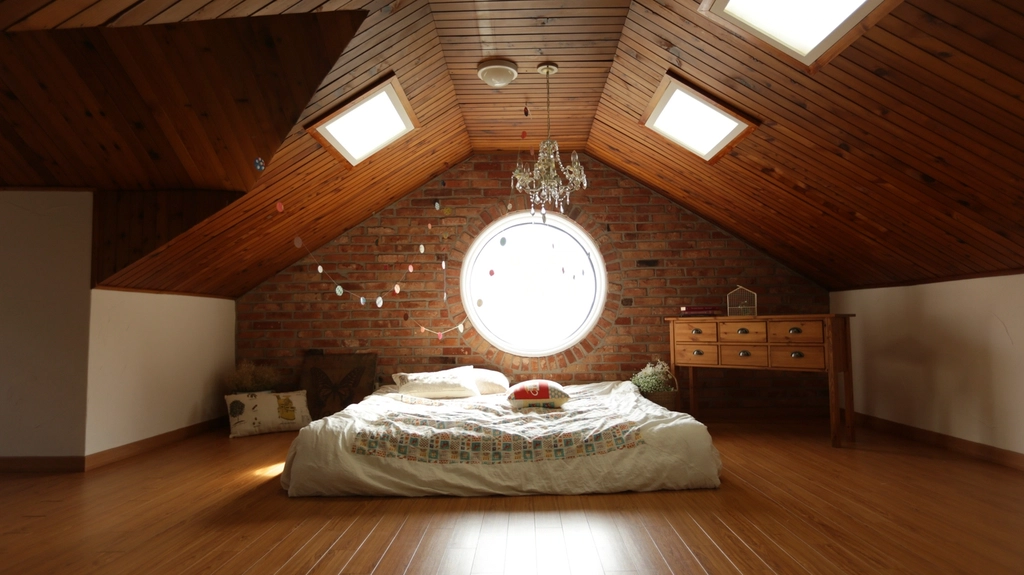
No height rule survives contact with a sloped ceiling unedited — angled ceilings need slope adapters and re-measured clearances, and that is the one case where a fixture’s install manual, read before purchase, beats every rule of thumb on this page. Attic bedrooms and converted lofts almost always end up with recessed or flush options for exactly this reason.
Measure twice, hang once
Grab a tape, mark the 7-foot line on the wall in each walkway, and measure ceiling height at the fixture’s actual location — floors and ceilings are rarely flat, and older houses especially settle. Then pick the fixture whose lowest point clears every zone it hangs over. Ten minutes of tape measure beats a canopy-shaped dent in your forehead.
Frequently asked
- How low can a ceiling light hang in a bedroom?
- Nothing should hang below 7 feet from the floor anywhere you walk — that is the working clearance in most building codes. Over the bed the rules relax, since nobody walks there; a pendant can drop to about 12 inches above the headboard top.
- What fixture height works on an 8-foot ceiling?
- Flush mounts work everywhere on an 8-foot ceiling. Semi-flush fixtures are fine if they hang no more than about 10 to 12 inches below the ceiling, and pendants belong only over tables, nightstands or corners nobody walks through.
- How far should a pendant hang beside the bed?
- Measure from the top of the nightstand to the bottom of the shade and keep it around 18 to 24 inches. That puts the light source near eye level when seated for reading while leaving headroom for anyone standing to reach the lamp switch.